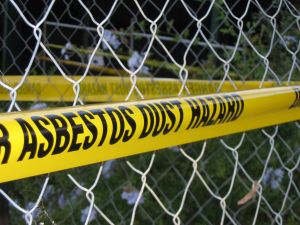
Recently in Asbestos Exposure Category

Boston Asbestos Exposure From Improper Removal Leads to Charges

May 15, 2012

Asbestos exposure in a Boston suburb has resulted in criminal charges, and our Boston mesothelioma Lawyers understand that the 59-year-old landlord is accused of violating the Massachusetts Clean Air Act. roof.jpg

According to MassLive.com, the incident happened in Grafton, about one hour west of Boston.

The woman is reportedly charged with three violations of the state's Clean Air Act, and was specifically accused of improperly having asbestos removed from her property.

The defendant in this case purchased a property back in the late summer of 2007. Shortly after her purchase, she sent a formal notice to the Massachusetts Department of Environmental Protection. In that notice, she informed them of asbestos that was found in the roofing components, as well as in the wall board. Now unfortunately, many older structures in Boston still contain asbestos, despite the fact that the federal government barred its further use in U.S. products beginning in the 1970s.

But because its use was so prevalent throughout the first and middle part of the 20th Century, asbestos is still being found in a number of residences - especially in older, more established cities, like Boston.

Asbestos exposure can be deadly when it's inhaled, causing fatal cancers, like mesothelioma. However, exposure doesn't mean immediate demise. In fact, people may go many years before ever realizing they've been put at risk. By the time they are diagnosed with mesothelioma, their life expectancy is significantly reduced.

So when a property owner becomes aware of the asbestos, there are very specific procedures they have to follow in order to remove it. For instance, they have to a hire a contractor who is certified to handle the asbestos removal.

What allegedly happened in this case was that the property owner, back in the autumn of 2009, started paying two prospective tenants to begin renovation work on the property. That renovation work included removal of the siding.

The property owner knew of the existence of asbestos, as evidence by the letter she sent to the DEP back in 2007. And yet, the state contends she did nothing to warn the tenants that the work they were doing was putting them at serious risk for asbestos exposure - and all the illnesses that come along with that.

To make matters worse, the prospective tenant's CHILDREN were also helping with the work. The landlord knew this too, and yet, stayed mum. These were individuals who had no training in dealing with asbestos, and they didn't have the proper equipment to protect either themselves or those in the surrounding neighborhood.

In addition, she didn't give the DEP a heads-up that the work was being started on, as she was required to do by law.

The DEP didn't become aware of the situation until the landlord hired a private company to dispose of the asbestos-laden material, which was piled up at her property.

The landlord has pleaded innocent to the charges, which include failing to follow proper procedures, improper asbestos storage and failing to give notice of an asbestos-related project.

As of yet, there is no indication that the tenants who did the work have filed a personal injury suit against their landlord, though it appears in this case, they certainly could.

Continue reading "Boston Asbestos Exposure From Improper Removal Leads to Charges" »

Boston Asbestos Exposure Watch: NYC Parents Protest

May 5, 2012

Our Boston asbestos exposure attorneys have reported on numerous cases involving children who are placed at risk when district officials or construction companies are careless with removal of the deadly material. school.jpg

We know that Boston asbestos removal must follow strict guidelines in terms of how, when and who can complete the work.

But even when assurances are given that work is being done properly, that doesn't always mean that every single party follows through. And when there are children involved, parents are understandably going to be upset.

We recently reported in our Boston Mesothelioma Lawyers Blog on asbestos concerns at Thorpe Elementary School in Boston, as well as those raised by a New York school that was hit by vandals, who unwittingly spread asbestos across the sidewalk.

Now, we understand that parents whose young children - ages pre-K through fifth grade - attend a Brooklyn school are voicing outrage that a renovation project may put the youngsters at risk. It's reached such a fever pitch that parents have protested and even staged a sit-in - so far to no avail.

Our Boston asbestos exposure attorneys stand behind these parents in their quest to have the multimillion dollar renovation project postponed until the summer break, when the potential risk to students can be substantially mitigated.

Parents say they weren't notified ahead of time that the work would be conducted. The renovation project, which started in March and is expected to span 18 months, involves working on the building's windows, roof and outside facade.

The school district says that the work will be done on evenings and weekends, when no students are in the building. It says the work will be conducted in areas that will be safely cordoned off from students.

But not only is this an inconvenience (what about after-school events or if a child forgets her homework?), the greater concern is how will the district be able to ensure that the asbestos dust will be entirely settled - and not a risk to students - when they show up for classes the following day? This is especially alarming because parents have already noted a build-up of dust from the construction on both windows and playground equipment. So far, there is no word on whether that dust has been tested for asbestos levels.

Asbestos was banned for commercial use in building materials in New York in 1972. But like Boston, many of its older buildings still contain the dangerous, cancer-causing material.

Some parents were mulling the possibility of keeping their children out of school throughout the duration of the project, despite planned, standardized math tests that were scheduled to take place.

School officials have said caving in to a requested delay could set a "bad precedent," causing many major projects to grind to a halt. But when it comes to children, could there be any better reason to use an abundance of caution, regardless of the impact on the speed of future projects?

Continue reading "Boston Asbestos Exposure Watch: NYC Parents Protest " »

Children Exposed to Asbestos in Boston

April 15, 2012

Irresponsible actions from an as-yet unknown source have put children at risk for asbestos exposure in Boston. sidewalkchalk.jpg

Our Boston mesothelioma attorneys are sickened by the news that someone has not once but twice dumped this deadly material in trash bins behind Thorpe Elementary School.

This incidents happened last month, and officials are still trying to find out who may be responsible.

Because of the inherent danger of asbestos, its removal is strictly regulated by the federal government's Department of Environmental Protection. Investigators there believe the dumping was done by a contractor who wanted to save money, as companies are responsible for hiring a licensed asbestos removal firm anytime they come in contact with the material. To dump this material anywhere would be bad enough. However, to do so at an elementary school is reprehensible.

News of this dumping comes as schools in Massachusetts are investing an estimated $9 million to remove asbestos from older buildings that were constructed with the naturally occurring mineral. Asbestos has been linked to cancer - namely, mesothelioma - as well as lung and heart disease.

The asbestos, which had been dumped in the same location twice in one week. School officials said it was discovered by a janitor, and the school had to pay to purchase new trash bins and have the other ones disposed of. The district said at no time were students at risk, although it's not clear how they can be certain, considering asbestos can easily go airborne, especially when disturbed. It doesn't seem there is any guarantee that no one else suffered potential exposure.

Another scary incident involving asbestos and school children was recently reported in New York. According to local news stations, children near one junior high school found pieces of asbestos, which they mistook for sidewalk chalk. Parents, too, though it was sidewalk chalk and had no idea their children had been playing with the deadly material. They are horrified - and rightly so, as the effects of asbestos exposure may lie dormant for decades before it is discovered. Typically, exposure involves inhalation of the fibers, which in turn scars the thin membranes surrounding major organs, including the heart and lungs. By the time asbestos-related diseases are discovered, patients are often given about one year to live.

In trying to determine how it happened, school officials are pointing to a recent vandalism incident. They say there was a break-in at the old school building in which hot water pipes were stolen. In the process, asbestos material was left all over the ground and on a nearby sidewalk. The incident prompted school and city officials to shut down half a block while a company has been hired to to clean up the mess on both the sidewalk and inside the school.

Some scientists say that a one or two-time exposure won't likely cause long-term damage, though there is no way to say that for sure. While there is no known cure for asbestos exposure, pediatricians for the children were advised to thoroughly wash or throw out the clothes they were wearing and undergo a complete check-up.

Continue reading "Children Exposed to Asbestos in Boston" »

Boston Asbestos Exposure Hits "Third Wave"

April 13, 2012

A third wave of mesothelioma cases are being discovered from asbestos exposure in Boston and throughout the country. amigos.jpg

Most of the cases our Boston mesothelioma attorneys handle are from individuals who worked closely with asbestos materials many years or decades ago. These were people who worked in mines or in manufacturing or construction.

Increasingly, however, more younger patients are being identified as "third wave mesothelioma patients," or those who were exposed as bystanders.

A prominent example was recently outlined in The Great Lakes Advocate newspaper. Australian Lincoln Hall gained notoriety in 2006 when he scaled the 28,000-foot Mount Everest, overcoming death-defying odds in surviving after suffering from a severe case of altitude illness which included brain swelling, hallucinations and extreme lethargy. He had been left for dead by the sherpas after deliriously trying to re-climb the mountain before collapsing. A crew returned expecting to find his body, but instead found him frostbitten - but, miraculously, alive.

Then late last month, he died from mesothelioma.

Reportedly, he and his father used to construct forts, known as cubby houses. Their makeshift play houses reportedly contained cement flat sheets that were made with asbestos.

This so-called third wave of sufferers are often younger than one might expect. That's because asbestos exposure can take sometimes as long as 40 years to reveal itself. Many of those individuals who worked directly with asbestos have either passed away or are expected to in the near future.

Asbestos, which is a naturally occurring mineral that has been known to cause lung and heart diseases as well as cancer, was used in a wide variety of products throughout the 20th century, but its use continued well into the 1980s in the U.S. Older structures and products continue to pose a threat, even though it may no longer be legally used here. Some countries, however, continue to use asbestos in their materials. Others have only recently outlawed its use - for example, Australia in 2003.

The fact that it's outlawed in the U.S. doesn't mean the exposure risk has been eliminated. The U.S. Occupational Safety & Health Administration is constantly citing building and construction companies for improper removal of asbestos, putting not only the workers but the general public at risk. Scientists have even gone so far as to liken asbestos waste to nuclear waste, in terms of the ravages it can inflict upon the human body.

Sometimes, new homeowners want to invest in an older home for its charm, only to find out too late that it was constructed with materials containing asbestos. There have also been multiple situations where asbestos was discovered in schools, churches and public buildings. These types of exposures are all part of this third wave.

In the U.S., there are an estimated 3,000 new cases of mesothelioma every single year, according to The American Cancer Society. The British Journal of Cancer has reported that mesothelioma cases are expected to peak sometime around 2015.

Continue reading "Boston Asbestos Exposure Hits "Third Wave"" »

Boston Asbestos Workers At Higher Risk of Heart Disease

April 12, 2012

Those who have suffered Boston asbestos exposure have not only increased their risk for mesothelioma, but also heart disease and stroke, according to a new British study. hearttree.jpg

Our Boston asbestos exposure attorneys know that the health risks when one comes into contact with this material are deadly. The problem is it was used in such a wide array of products for so long - even after companies learned of the health risks - that many people even today continue to come into contact with it.

Those who have the greatest exposure risk are workers in the shipbuilding, railroad, automotive and construction industries. However, because it can easily go airborne, exposure is by no means limited to these individuals. Also, the material has been known to have been widely used in schools, public buildings and homes. Those in older structures are particularly at risk.

It's long been known that those who are exposed to asbestos are at increased risk of lung diseases and cancers, including mesothelioma. Generally, the incubation period for these diseases - that is, the time it takes for you to know about it - is between 10 and 40 years.

Now, here's what the British researchers discovered:

They looked at the health histories of nearly 100,000 individuals who worked in the British asbestos industry between the early 1970s and 2005 - more than 20 years. Of those about 15,000 have died.

Of those 15,500 deaths, nearly 4,200 were the result of heart disease and more than 1,000 were from a stroke. This was especially true for women.

For male asbestos workers, it was learned they were more than 40 percent more likely than someone in the general population to die of a stroke. They were also 60 percent more likely to die of heart disease - and this was even when the statistics were controlled for cigarette smoking.

For women who worked with asbestos, those numbers were even more astonishing. They were 100 percent more likely to die of a stroke and 90 percent more likely to die of heart disease.

Keep in mind, male and female workers usually had somewhat different roles in handling the asbestos. The men were usually hired to remove asbestos, while the females had worked in industries that manufactured materials that contained asbestos.

The research was headed by Britain's Health and Safety Laboratory, and the results are spelled out in the Journal of Occupational and Environmental Medicine.

The reason why these findings are significant is that doctors had long believed that Boston asbestos exposure was tied to cardiovascular disease. But until now, they never had any solid proof.

This is also the first study that specifically looked at the link between heart disease and asbestos exposure that specifically controlled for smoking. About half the women in the study were in fact smokers.

This is another reason mesothelioma and other asbestos-related diseases are difficult to diagnose - they may masquerade as another disease.

If you are undergoing treatment for a disease you believe may be related to asbestos exposure - particularly mesothelioma - contact an experienced Boston mesothelioma attorney today.

Continue reading "Boston Asbestos Workers At Higher Risk of Heart Disease" »

Boston Mesothelioma Patients Can Sue Pfizer

April 12, 2012

Boston mesothelioma patients who suffered asbestos exposure from insulation products made by Quigley Co. Inc. can sue drug maker Pfizer, which had purchased the company back in 1968.redbloodcells.jpg

Our Boston mesothelioma attorneys understand this is a case that has been dragging on for more than three decades, and it's encouraging that a federal court has taken a stand on the side of consumer and patients' rights.

The case is called In re Quigley Company Inc, U.S. Court of the Appeals for the Second Circuit, Nos. 11-2635, 11-2767.

Because the litigation has spanned so many years, the details are somewhat convoluted, but we'll try to break it down.

First, Quigley Co. was a business that was founded in the early part of the 20th Century. From the 1940s through the 1970s, it manufactured products for the steel industry - three of which contained asbestos. This is a mineral material that was used in a host of products up through the latter part of the century, and it is known to cause various lung diseases and cancer - including mesothelioma.

Pfizer purchased Quigley in the late 1960s, making it a subsidiary of the larger firm. However, most of its operations were suspended in the early 1990s, and it filed for bankruptcy in 2004. That bankruptcy came amid a flood of lawsuits filed by some 160,000 individuals across the country who had suffered asbestos exposure from Quigley's products.

In 1999, the lawsuits started coming in. No doubt that the reason it took so long to file these cases is that mesothelioma, a rare form of cancer that consumes the thin layer of cells that line the internal organs, in almost every instance isn't revealed until years or decades after exposure. By then, the patient has about 12 months to live. In all likelihood, most of these cases are being carried on by mesothelioma survivors.

In 2011, Pfizer struck a deal with lawyers who were representing about 80 percent of those 160,000 individuals. That settlement resulted in $430 million worth of payouts. The bankruptcy was part of the whole deal, and Pfizer's hope was that would be the end of a saga that started in the 1970s.

A bankruptcy court sided with Pfizer in issuing an injunction that stopped some of the lawsuits that were still pending from moving forward. The cases seemed stagnant until last year, when a federal judge in New York reversed that order, saying those cases could proceed. Now, the federal court of appeals has upheld that order - meaning the rest of the lawsuits, as well as any others that may have arisen in the interim, can once again continue.

Pfizer's arguments in the past have been based on their claim that they shouldn't be responsible for products that were made by Quigley - products they did not directly manufacture. However, Pfizer was deriving profit from these products. And as such, they should have to pay for the subsequent damage inflicted.

Continue reading "Boston Mesothelioma Patients Can Sue Pfizer" »

Boston Asbestos Exposure Leads to Criminal Charges

April 5, 2012

Not only were a property owner and contractor reportedly complicit in a Boston asbestos exposure case that may have imperiled young children, one of them is now also accused of witness intimidation.handcuffsonhands.jpg

Our Boston asbestos exposure attorneys are appalled at the news coming out of Dedham from the state attorney general's office.

The fact is, asbestos is the cause of mesothelioma, a dangerous cancer that can take years to detect. Once it's diagnosed, it's a death sentence and patients are given about a year to live. The diagnosis is devastating to families, who are often blindsided and had no idea, as the exposure may have happened years earlier.

According to a recent press release, the property owner, 58, is from Weston and the heating and cooling contractor, 41, is from Plainville. Each of the two were arraigned on criminal charges - four altogether - for violating the Clean Air Act. Specifically, the two are accused of failing to notify the state's department of environmental protection about the presence and removal of the asbestos at a residence where a family with small children lived. They also didn't hire a company specializing in safe asbestos removal.

The state's Department of Labor Standards is very strict on its requirement that whenever an individual or company is removing asbestos, the work has to be completed by a licensed contractor, trained in asbestos removal. That removal has to follow very specific standards in terms of how the materials are handled, how they must be stored and how they should be disposed of. Throughout this whole process, the department of environmental protection needs to be informed - and its the contractor's responsibility to do that.

Court records indicate that in December of 2010, the property owner hired the heating and cooling contractor - who was not licensed to perform asbestos removal - to replace a boiler in the basement of the residence. It's alleged that the contractor did not seal off the basement when he did this work, which would have helped to ensure that exposure to that family and their small children would have at least been limited.

It's not clear exactly how environmental authorities learned of this alleged violation, but once they did, they immediately conducted an investigation, with the assistance of the Massachusetts Environmental Strike Force - a multi-agency coalition that works together to investigate and prosecute individuals who have committed crimes that potentially threaten the land, air or water or could otherwise pose a significant health risk.

When the contractor learned he was being investigated for potential criminal violations, authorities say he went to the home where he did the work and threatened the tenants - the ones with the small children who had been exposed to asbestos - saying he would inflict some harm if they testified against him.

As of right now, both defendants have pleaded not guilty in the case, and have been released on their own recognizance, although the contractor was ordered to have no contact whatsoever with the tenant/witness.

A pretrial conference for the pair is expected to be held the first of May.

Continue reading "Boston Asbestos Exposure Leads to Criminal Charges" »

Boston Asbestos Exposure to Cost Firms $88,000

April 2, 2012

For their role in a Boston asbestos exposure case, four companies could be required to pony up an estimated $80,000 in penalties. lungs.jpg

As our Boston asbestos exposure attorneys understand it, Massachusetts Attorney General Martha Coakley has announced that the companies were each involved in work being conducted at the Lowell Sun Newspaper near Kearney Square. They are accused of failing to properly remove and dispose of asbestos on the property.

Coakley released a statement saying her office would aggressively go after those who violate the laws regarding asbestos removal, as such regulations are laid out by numerous entities, including the Occupational Safety and Health Administration, the U.S. Department of Transportation, the Environmental Protection Agency and the Massachusetts Department of Environmental Protection, as spelled out in Massachusetts statute 310 CMR 19.061.

That's a lot of government oversight, but what it basically comes down to is this: Companies that work with asbestos have to follow very specific laws when it comes to not only how they protect their workers from exposure, but also how they protect the rest of us. Asbestos, which causes the long-latent but deadly cancer mesothelioma, can be spread through air particles or water. So if it's not disposed of properly, we're all at risk.

The state has a number of asbestos investigators whom they rely upon to check up on contractors and insure they are doing their jobs properly.

The complaint, which was by the attorney general's office in Suffolk Superior Court, alleges that the four businesses - all limited liability companies based in Tewksbury, flouted the federal Clean Air Act when they removed of pipe insulation and ceiling tiles that contained asbestos, without using the right containment procedures that would ensure the asbestos wouldn't be released into the environment. They also reportedly didn't notify the state's Department of Environmental Protection of what they were doing, as they were also required.

The companies had been working to convert the former newspaper building into condominiums in 2009.

Now, a settlement has been reached that will require the main company and the general contractor to pay $80,000 - although $30,000 of that would be forgiven if the defendants followed all the stipulations laid out by the court, though Coakley's office did not make clear what those stipulations were.

The newspaper, which had left the building in 2007, was not named as a party in the complaint.

Officials shut down the conversion work as soon as it learned of the violations. The four companies were then responsible for bringing on a licensed asbestos removal firm. The state's environmental officers say they don't believe asbestos spread far enough to negatively impact anyone - though that always remains to be seen, as many people don't realize they've been exposed until many years later, and often not before it's too late.

Continue reading "Boston Asbestos Exposure to Cost Firms $88,000 " »

Boston Mesothelioma Lawyers Hail UK Victims' Victory

March 30, 2012

Those suffering from mesothelioma in Boston should be encouraged by news that has just come out of London, where thousands of families will now be able to file insurance claims for their conditions. thumbsup.jpg

Our Boston mesothelioma attorneys have been closely following the news from across the pond, where the nation's supreme court ruled that the insurance liability was induced at the time that the individual was exposed - not when the disease was first discovered.

This is crucial in mesothelioma cases because, as we've discussed on our Boston Mesothelioma Lawyer's Blog, this is a cancer that often doesn't reveal itself for years - usually decades - after the initial exposure. By that time, it is often too late for individuals to seek any kind of effective treatment. In fact, patients usually have less than a year to live.

That leaves their loved ones to pick up the pieces.

In this case, medical insurance companies in England took a gamble by filing the case in the first place, asking the court to make a decision. The companies argued that they shouldn't have to cover someone from the time they were exposed to the asbestos that caused the cancer, but rather from the time the symptoms first began to appear. Of course, that is the difference between a years-worth of coverage and a few decades-worth.

Instead of ruling in their favor, however, the country's supreme court has set a precedent for the victims - and rightly so. In fact, the court noted that there is a clear link between the person's employment and the asbestos exposure that caused the sickness -- that if the courts were to agree with the insurance companies, it would mean huge coverage lapses for workers, particularly those individuals who aren't employed by the same company anymore.

Attorneys for the victims were quoted by CNN as saying they were overjoyed with the court's decision, adding that it will provide comfort to victims and their families, as well as clarity and consistency for individuals who will discover the cancer in the future. That's going to equal financial security for the families of those affected by this awful - and preventable - illness.

In Britain, disease resulting from asbestos exposure is said to be by far the biggest killer in the workplace. In fact, some 5,000 people die of it in England annually. The numbers continue to rise there, as more people discover they have been impacted. It's expected to peak by 2015.

While the ruling doesn't affect Boston mesothelioma patients, we can stand in solidarity that a victory for even one patient is a victory for all patients.

Continue reading "Boston Mesothelioma Lawyers Hail UK Victims' Victory" »

Are You a Foreseeable Victim in Your Boston Mesothelioma Case? See Simpkins v. CSX Corp.

March 26, 2012

In our daily lives we can be oblivious to the potential harms around us. If you have been diagnosed with mesothelioma you might wonder how you were exposed to asbestos and not have know the potential harms.
couple.jpg
Having a Boston mesothelioma attorney is critical to getting the award you deserve. Our attorneys have the experience and tenacity to identify the proper arguments and parties in your Boston mesothelioma case.

Simpkins v. CSX is a case where the plaintiff's husband was exposed to asbestos daily while working for the defendant. Upon returning home from work each night, there was asbestos residue on his clothing. This caused his wife to inhale this asbestos and subsequently suffer from mesothelioma. Plaintiff sued her husband's former employer claiming negligence, wanton and willful conduct and strict liability.

In a case for negligence, the plaintiff has the burden of proving by a preponderance of the evidence all of the elements of negligence. Plaintiff has to prove that the defendant had a duty to the plaintiff, the defendant breached that duty, the breach of duty was the direct and proximate cause of the plaintiff's injuries, and the plaintiff suffered damages. Simpkins argues that as to her negligence claim, the defendants failed to take the proper precautions to protect plaintiff's husband and their family from the potential "take-home asbestos exposure."

Strict liability is an imposition of liability where the defendant is engaged in ultrahazardous activity. Plaintiff argued that the defendants should be held liable because they were engaged in activities with products containing asbestos.

On the other hand, CSX claimed that no liability can be imposed on them because they did not owe any duty to a third party non-employee who was exposed to asbestos, like the plaintiff. Furthermore, plaintiff was not an employee of the defendant and had never been on the work premises. Because of this lack of a direct relationship between the plaintiff and defendant, defendant argues they had no duty to plaintiff.

This conflict over whether there was a duty involved in this case led the court to analyze the entire concept of duty. In order to do this, the court looked to public policy in their consideration of the relationship between the plaintiff and the defendant. The court cites prior case law where this relationship is further analyzed and divided into four separate components. These components are: the reasonable foreseeability of the plaintiff's injury, the likelihood of the injury, the amount effort needed to protect from injury, and the consequences of placing this burden of prevention on the defendant.

What is crucial in this case is the general rule that states that there is no duty to rescue a stranger. However, where there is a special relationship a duty to take these affirmative actions can be created. But the court here explains that the relationship between the plaintiff and the defendant does not constitute as one of these four special relationships.

Plaintiff in this case proved that her husband worked for defendants and that plaintiff's husband was exposed to asbestos. Plaintiff also showed that it was reasonable to find that her husband carried this asbestos home on his clothing. However, she failed to prove that the defendant knew or should have known that there was an unreasonably high risk of harm to the plaintiff. To prove this, plaintiff would have had to show specific facts that would prove that the defendant had actual or constructive knowledge of this risk of harm to plaintiff.

Illinois Supreme Court in this case found that in this cause of action for negligence the main issue was whether the defendants could have reasonably foreseen that their actions could cause the plaintiff's injuries. Basically, the defendant's owe a duty of care to foreseeable victims.

In analysis, the plaintiff did prove that the defendant's acts or omissions contributed to the risk of harm to the plaintiff. However the second part of the duty analysis rests on the four components of the relationship discussed above. Because plaintiff did not prove that her injuries were foreseeable this court found her pleadings insufficient and they remanded it to the lower court for further proceedings.

There are so many components to every theory in every area of law. Having an experienced attorney guiding you can give you the peace of mind you need to concentrate on your health.

Continue reading "Are You a Foreseeable Victim in Your Boston Mesothelioma Case? See Simpkins v. CSX Corp." »

Daley v. A.W. Chesterton Discusses Remedies for Multiple Diseases Associated with Asbestos Exposure

March 8, 2012

If you were diagnosed with mesothelioma in Boston as a result of asbestos in the workplace you may be thinking that suing a large company will be no easy feat. Do not get discouraged. Our Boston mesothelioma attorneys have the knowledge and experience to take on the big companies to get you the award you deserve.
asbestos.jpg
Cancer runs rampant in our country but mesothelioma is very unique. Mesothelioma is cancer, usually in the respiratory system that results from exposure to asbestos. Asbestos is a dangerous substance that has been linked to usage in the manufacturing and building industries.

Daley v. A.W. Chesterton is a case that arose because a laborer who was working in the manufacturing sector became ill because of his exposure to asbestos. He was diagnosed with two malignant diseases over a span of 16 years, and he sought compensatory and punitive damages from several parties who were responsible for this exposure.

Compensatory damages are the quantifiable damages that are measured monetarily to replace strictly the financial loss to the plaintiff. In instances where there is injury or disease that resulted because of the defendant's negligence, compensatory damages would be awarded to compensate the plaintiff for the medical bills incurred for treatments resulting from that defendant's negligence. Punitive damages have the intention of punishing the defendant and deterring the negligent behavior, and are awarded for things like pain and suffering.

In Daley, the Supreme Court of Pennsylvania was charged with the question of whether a plaintiff could bring more than one separate lawsuit where the plaintiff was diagnosed with more than one malignant disease that was the result of the same asbestos exposure.

Pennsylvania has a state statute called the two disease rule. This rule allows individuals to bring separate lawsuits where the plaintiff can prove that he or she was diagnosed with more than one malignant disease that was the result of defendant's negligence.

The plaintiff in this case was first diagnosed with pulmonary asbestosis and squamous-cell carcinoma in his right lung. These diseases can be directly attributed to exposure to asbestos. He sued several parties and obtained a settlement in the mid 1990s.

More than 10 years later, the plaintiff was diagnosed with malignant pleural mesothelioma. This cancer can be directly linked to the same asbestos exposure that gave the plaintiff the original diagnosis. Plaintiff then sued several different parties for negligence and cited this two-disease rule.

The defendants in this case argued that the doctrine of res judicata precluded this action. Res judicata is a doctrine surrounding claim preclusion in that a suit cannot be brought if the main issue in the second suit is exactly the same as the first and there are the same parties to the action. Basically, they argued that the plaintiff lost his right to sue these parties in the second litigation when he sued the original parties to the lawsuit because the diseases arose out of the same asbestos exposure.

The court cited that this was incorrect reasoning because none of the defendant named in the second litigation are the same as the defendants named in the first case that was settled in the late 1990s. Additionally, the court discussed this two-disease rule, which is a limited exception to the original cause of action requirements created by the state legislature to provide relief for asbestos-related diseases.

In application, the plaintiff was allowed to sue the different defendants in the second case for a different malignant asbestos related disease arising from the same asbestos exposure that led to a prior settlement for damages associated with a different malignant disease. The plaintiff was allowed to do this because at the time he brought the original claim, he had no knowledge of the existence of the second asbestos-related malignant disease.

Consequently, this court decided that the separated disease rule of Pennsylvania allowed this plaintiff to file a second cause of action for the new malignant asbestos-related disease.

Having an experienced legal team can be very beneficial in navigating your way to the award you deserve.

Continue reading "Daley v. A.W. Chesterton Discusses Remedies for Multiple Diseases Associated with Asbestos Exposure" »

New England Veterans Suffering from Mesothelioma Offered Part of $75 Million Trust by Navy Supplier

February 20, 2012

A company that for half a century provided asbestos-laden parts to the U.S. Navy recently set up a $75 million asbestos trust for veterans who may have been exposed and suffered illnesses because of it.

Many U.S. veterans were exposed to asbestos while serving aboard Navy ships when the government regularly used this natural mineral as an insulation and a protector from fire. It was used in piping, valves and other parts to resist heat and fire. The flaky mineral can easily be ingested and lead to tumors that grow on the lining of major organs on patients with mesothelioma in New England.
navyship.bmp
Our Massachusetts mesothelioma lawyers have met many veterans who served faithfully in order to protect our country's freedom. Yet during that service time, they were exposed to asbestos. In many cases, the companies that supplied the products laden with asbestos knew of their effects or at least had been warned that people were getting sick.

Yet unsuspecting veterans were working on these U.S. Navy ships and in shipyards where asbestos was commonly found. Decades later, far after retirement, these men and women are now getting sick and being diagnosed with major illnesses, including mesothelioma, which is deadly and has no cure.

A person can be exposed to asbestos at a young age and live with the cancer for years without it showing any outward symptoms or signs. By the time a person feels those symptoms -- commonly reflected as heavy coughing, chest pain, fluid build-up and others -- it's typically too late. The cancer is in its advanced stages and there are few treatment options that can help.

According to several sources, Leslie Controls Inc., as part of a bankruptcy reorganization plan, has dedicated $75 million to victims of asbestos exposure. The company provided valves and gaskets that were covered in asbestos for the Navy between the 1940s and 1980s. The company has been named in a growing number of asbestos-related and mesothelioma lawsuits. The company filed for bankruptcy in 2010.

The legal strategy of the company is to be able to handle all current and future litigation that may crop up because of the company's use of the dangerous mineral. The fibers, research has shown, are the primary cause for mesothelioma and other respiratory ailments.

The U.S. Navy is protected from direct lawsuits under sovereign immunity and Feres Doctrine laws. However, individuals may file lawsuits against manufacturers that contracted with the government on a regular basis. Leslie has previously contended that its products didn't contribute to asbestos exposure for veterans.

All lawsuits were halted in 2010 because of the bankruptcy filing. Once the reorganization plan is approved by the court, the lawsuits are expected to continue. The company continues to manufacture and supply valves and subsystems in the energy, industrial and aerospace markets.

Continue reading "New England Veterans Suffering from Mesothelioma Offered Part of $75 Million Trust by Navy Supplier" »

Company Lobbies to Limit Asbestos Liability, a Lesson to Mass. Lawmakers

February 15, 2012

A company that manufactures cans in Minnesota is attempting to use lobbying efforts to try to shield itself from asbestos lawsuits after workers have complained of getting sick, the Star Tribune is reporting.

This can be a lesson to Massachusetts lawmakers who must deal with the problems here associated with constituents who are exposed to asbestos in New England. While there are no longer active vermiculite mines that may contain asbestos, that doesn't mean people here couldn't be exposed - or haven't been already.
mfXjRRi.jpg
Our Boston mesothelioma lawyers understand that mesothelioma doesn't get the same time of attention that other forms of cancer may get. It is fatal, though, and there is no known cure.

Companies that have old factories or old manufacturing plants often are faced with the problem of having asbestos it the walls or in piping. This can cause employees to be exposed to asbestos, which in turn causes long-term health problems.

In Minnesota, a company that has three manufacturing plants is hoping to change state law that could limit the number of asbestos claims stemming from a merger in the 1960s. The company says current laws have caused it to have to pay $700 million in claims and lawyer fees on top of $1 billion in borrowing costs associated with the litigation.

Lawyers say the proposal, which is up for a vote in the state senate, is the company's way of trying to skirt the rules and get the law changed so they can protect themselves from lawsuits. Experts say that if the law is changed to help this company, it could affect all companies and set a bad precedent for future lawsuits.

The company currently has about 150 asbestos cases statewide, with most being filed in the last 15 years. In the last year, only a few have been filed, lawmakers say. Company officials say they hope the law change will help their image with Wall Street.

Analysts believe that current litigation could take decades to be completed and it could go on into the future because health problems with asbestos exposure can take decades to detect. Future victims who don't know they're sick could end up being affected if this measure is passed.

This is a good lesson for Massachusetts lawmakers because it's possible that Massachusetts residents could attempt to bring similar litigation here. Big companies with many employees, including past employees who may have been harmed by asbestos exposure, may file future lawsuits.

The tricky thing with mesothelioma is that workers may not find out about the cancer until years in the future, even though they were employees decades ago. Therefore, if politicians attempt to help these companies -- which may have put these workers at risk by letting there be asbestos in their buildings -- by changing the laws, it could mean major problems in the future.

If employees aren't able to get the help they need to pay for major medical bills, they may have nowhere to turn. It's important that the laws are in place to help employees who may have been harmed or killed because of company negligence.

Continue reading "Company Lobbies to Limit Asbestos Liability, a Lesson to Mass. Lawmakers" »

Schools to Spend $9 Million to Remove Asbestos in New England

February 13, 2012

East Providence officials recently agreed to a plan to spend $9 million clearing out asbestos from schools in that city, showing that asbestos in New England is still an issue.

Our Boston mesothelioma lawyers recognize that asbestos isn't something many citizens are constantly thinking of today. Some people think of it as a problem of the past -- one that only affects older generations.
file0001321608732.jpg
And while older citizens often are the ones suffering from asbestos-related illnesses, such as mesothelioma, the fact that school districts are still today trying to clean asbestos out of their facilities shows that it still may be a problem. And if our children are exposed to asbestos, it will only create a new generation of sufferers.

On the one hand, it's encouraging that school districts are earmarking funds that will be designed to eliminate dangerous asbestos from schools throughout our communities. On the other, however, it's disheartening that in 2012 asbestos is still in many of our schools, possibly affecting our children.

Research has shown that even a small amount of asbestos exposure can cause major issues years later. With mesothelioma, victims could have been exposed as many as 30 or 40 years ago, and have no symptoms. Once they are checked out and diagnosed, the incurable cancer is in its advanced stages. The median survival rate after diagnosis is only 12 months. That's what makes this cancer so frustrating -- it takes so long to develop and then kills swiftly.

While asbestos was a natural mineral used for insulation for decades -- from about 1910 to 1990 -- researchers began finding that exposure caused sickness around the 1970s. So, it's now been more than 40 years that people have known asbestos is dangerous, and yet it is still in our schools today.

Renovating or properly removing asbestos can be dangerous. But letting it sit and possibly become disturbed may be more dangerous - even deadly. No parent wants to send their child to a school where they could be harmed simply for walking in the front door.

At least Rhode Island officials are taking the situation seriously. According to the East Providence Patch, the Rhode Island Building Energy code secured $9 million to renovate several schools. The plans were held up as officials tried to get the funding to do the projects.

Officials hope that their efforts will be done by the summer so that the schools will be free from the harmful materials by the new school year. Health department officials said they were happy with the news. They had mandated air testing at the schools. Contractors said they will work closely with health officials to ensure that the renovation is done properly and licensed asbestos removal experts are hired to do the job. This is a highly regulated field, which shows the importance of doing it right the first time.

Continue reading "Schools to Spend $9 Million to Remove Asbestos in New England" »

Developer Faces Criminal Charges in Asbestos Exposure Case

February 10, 2012

Recent news out of Upstate New York shows that developers there are unable to follow the law regarding asbestos removal, just like construction workers from Massachusetts.

Our Boston mesothelioma lawyers have reported before on our Mesothelioma Lawyers Blog about situations where real estate developers try to skirt the law and end up getting arrested.
file0001354457655.jpg
Two Plainville men -- one a contractor and one a home owner -- were recently charged with improperly removing asbestos from an old house in Medway. Rather than hire trained asbestos removal experts to do the job, they tried to do it themselves. Not only did they probably expose themselves to asbestos, but they could have put others in danger. Asbestos exposure in Massachusetts is the leading cause of mesothelioma.

Asbestos is flaky and can easily travel through the air. This is where it's most dangerous because people can ingest it through their mouths or noses without even knowing. And even a small amount of exposure can do damage.

Mesothelioma is a rare form of cancer that is caused by exposure to asbestos. The asbestos can travel through a person's system and attach to major organs, making operation difficult or impossible. Chemotherapy is an option, but not a cure. Researchers are working on figuring out a better way to treat the cancer.

In this case, according to NBC News, a 28-year-old developer now faces up to 10 years in prison plus a $250,000 fine after being charged with violating the Clean Air Act. He faces two counts of the crime.

Prosecutors say the man was working on a downtown Livingston County warehouse he owed. He hired workers to haul large quantities of asbestos without getting approval or hiring a trained expert in the field.

A state inspector visited the work site one day in December and saw large materials near a dumpster that looked like asbestos. After testing, it was confirmed to be the dangerous mineral. Nearly 100 bags of dry, friable asbestos were found and tested. Employees were working nearby the asbestos, which was sitting out in the open.

Prosecutors say that any person who may have been near the site between August 1 and December 14, 2011 could have been put at risk of asbestos exposure. Any gust of wind would have taken that flaky asbestos and sent it all around the area. People could have easily been exposed without knowing it. It would be prudent for people who live in the area to be seen by a doctor.

Sadly, if not for a complaint that led to an inspection, the problem may never have been exposed. People would have ended up with mesothelioma years in the future not knowing why. This happens, as developers try to save money by improperly removing asbestos. It is not used in this country for a reason -- it's dangerous.

Continue reading "Developer Faces Criminal Charges in Asbestos Exposure Case" »