Articles Posted in Asbestos Exposure

A number of low-income tenants in Yarmouth, about an hour south of Boston, near Hyannis, are protesting an asbestos abatement project they fear could pose undue risk to their health.

renovationtime.jpg

Our Boston asbestos exposure attorneys understand that a number of tenants are elderly and disabled and a number are children under the age of 12.

The safe removal of asbestos is a major issue in Massachusetts for several reasons, namely:

  • There is so much of it;
  • Proper removal is expensive.

Asbestos can be found in a long list of home products, including insulation, flooring, roofing, joint compounds, decorative plasters, wallboards, mastics, fireproofing and ceiling tiles.

The Massachusetts Environmental Protection Agency generally holds that if these materials are in good condition, they should be left alone, as they will pose little to no risk. The danger is when the fibers in these materials are disturbed and become airborne. If people nearby aren’t equipped with proper respiratory protection, those fibers become snagged in delicate lung tissue and cause severe to terminal illnesses such as asbestosis and mesothelioma.

The sole case of these ailments is asbestos exposure. Despite what many asbestos defendants attempt to claim in court, there is no such thing as a safe amount of exposure to this fiber. Although asbestos ailments are deadly, they lie dormant for decades. When they do manifest, the progression tends to be rapid and decline is swift.

That’s why when asbestos renovation work is to be done in Massachusetts, it must be conducted according to 310 CMR 7.15. This statute requires that all owners, renovators, contractors and plumbers have to determine asbestos materials at a site prior to conducting any work.

If asbestos is located, it’s strongly recommended that only a certified Division of Occupational Safety worker perform that work, as there are a laundry list of operational and disposal requirements that must be met in order for the removal to be safely carried out.

In Yarmouth, residents say they received a short letter explaining that their flooring would need to be replaced and that they could “expect some debris.” No mention was made in that letter that the vinyl flooring to be replaced actually contained asbestos. Some residents, however, were aware of this fact and are fighting back to raise awareness within the complex and also to encourage the owners to reconsider the renovations, considering the floors, while stylistically outdated, are not in bad condition.

The Boston-based management company said the work area within the one-bedroom units would be blocked off with plastic and tenants would be given the option to remove their food while work was underway.

Tenants were offered to stay in the community day room while asbestos abatement was occurring, but no overnight accommodations were offered.

Some residents were advised by the EPA to bag their belongings prior to the abatement.

But it appears the work will go on, at least in 42 units of the 150-unit complex.
Continue reading


With our technology and medical knowledge expanding exponentially, it’s inevitable that the justice system would be relying more heavily on such information as evidence.
asbestos.jpg
But when medical, scientific and legal opinions intersect, it can make for a contentious battle. Nowhere is that more evident than in mesothelioma cases.

In 2011, a Pennsylvania judge awarded the estate of a deceased mesothelioma plaintiff a $950,000 sum from an electric company for its negligent exposure of the vicitm to asbestos fibers through its welding rods.

The electric company, however, appealed that decision. Our Boston mesothelioma lawyers have since learned that the appellate court affirmed the earlier ruling, refusing the company’s challenge to the “any exposure” theory, despite an earlier ruling by that state’s supreme court, which found that the theory is not sufficient to establish causation.

The case, Wolfinger v. Lincoln Electric Company, provides some hope that judges and justices will continue to hand down common sense decisions, even in states where patients’ rights have been actively restricted.

If you aren’t familiar, the “any exposure” theory basically holds that each and every exposure to every kind of asbestos in a workplace setting may constitute causation for the disease.

Many courts reject this, and plaintiffs are often required to show evidence of repeated exposure – despite the fact that doctors and researchers agree no type or amount of asbestos exposure is safe.

In 2005 in Pennsylvania, plaintiffs in Betz v. Pneuma Abex attempted to assert that any exposure to asbestos, even casual, was basis enough to assert causation of mesothelioma or asbestos-related illnesses. This was the argument used, even though the plaintiff in that case had in fact suffered repeated exposure to the fibers in brake linings through his decades of work as an auto mechanic. The court, however, rejected that “any exposure” theory, and that precedent has been upheld in that state ever since.

Then came the Wolfinger case. Lincoln Electric appealed the initial verdict on several grounds, including that:

  1. The court had erroneously allowed expert testimony indicating that “any exposure” to the defendant’s asbestos-laden products was causation, in violation of Betz;
  2. The trial court erred in allowing the plaintiff’s doctor to testify as to the root cause of his illness.

The court, however, rejected those arguments on the basis that despite the doctor’s testimony – specifically with regard to the “any exposure” theory, it was not the only evidence offered by the plaintiff as to causation.

In other words, the plaintiff’s attorneys didn’t leave it up to this one witness to find a casual link. As such, the earlier verdict was upheld.

Once again, it is critical for the plaintiff attorney to thoroughly research every aspect of a claim before moving forward. Choosing an attorney who is committed to that level of dedication will be critical to the success of your case.
Continue reading

In looking at a New England mesothelioma claim, who would you suppose to be the true victim?
subwaypeople.jpg
Our Boston mesothelioma lawyers would assume the answer is a no-brainer: The patient who has been diagnosed with this aggressive terminal cancer and the loved ones who are suddenly left to carry on without them.

Apparently though, insurance companies would have you think differently. According to the insurance firms who had contracted with asbestos defendants, they are the true victims. These were firms that purportedly had no knowledge of the ongoing negligence by the companies with which they were doing business and therefore had no idea that this current “flood” of mesothelioma claims would in time be in the pipeline.

In reality, they likely charged a premium for that risk and are now trying to dodge responsibility. Now that the insurance firms are on the hook, at least partially, for the damages, they are trying every tactic possible to either limit their own liability or make it tougher for mesothelioma victims to sue in the first place.

That’s right. Rather than simply owning up to the responsibility they accepted when they signed on with firms that later turned out to be deceptive to the point of endangering workers and consumers, they are placing the blame squarely on mesothelioma patients and their attorneys. According to these companies and their advocates, the fact that so many people are coming forward with mesothelioma diagnosis MUST be evidence of some form of fraud, and the “greedy lawyers” are all too happy to be complicit in efforts to bully them into paying up.

They’re argument lacks any substance when you consider that exposure to asbestos is expected to claim roughly 500,000 lives in the U.S., peaking in 2015. The reason there are so many plaintiffs is because there are so many people sick, dying and grieving because asbestos defendants produced dangerous products and/or failed to warn employees and consumers about the risks.

What’s driving insurance firms’ sudden activism is a recent ratings report that insurers will need to set aside at least $85 billion to cover these claims – $11 billion more than expected. That still only breaks down to about $170,000 per patient.

One of the most blatant means by which insurance firms are trying to muzzle mesothelioma victims is through the political lobbying group The American Legislative Exchange Council. ALEC has been active in teaming up with legislators in Ohio, West Virginia, Louisiana, Oklahoma, Texas and at the federal level to protect corporations from exposure to claims by making it tougher for victims to file suit. Legislation in these places has been introduced or has been drafted, which makes more requirements of plaintiffs and drags the process out much longer. Meanwhile, these companies have full knowledge that doing so is likely to make the life of the lawsuit outlast the life of the plaintiff.

Is it any wonder then that insurance companies fare poorly in terms of overall public trust? Recent surveys have shown that while more than 70 percent of Americans trust retailers and 65 percent trust food manufacturers, less than 40 percent trust insurance companies.
Continue reading

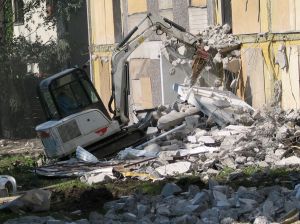
A Superior Court judge in Massachusetts recently slapped a demolition firm with a $100,000 penalty for failure to properly remove and dispose of asbestos waste during numerous projects. oldhouse.jpg

Our Boston mesothelioma lawyers never cease to be amazed by these businesses that continue to take chances with this deadly substance, despite their awareness of the risk it poses to their employees, the public and the environment.

Asbestos is a naturally-occurring fiber that was used extensively throughout the 20th century for everything from auto parts to ceiling tiles. But it was known throughout this time to be a carcinogen when the fibers were inhaled. A person will show no symptoms for decades, and then be diagnosed with mesothelioma sometimes 40 or 50 years after exposure. Upon diagnosis, the disease progresses rapidly and is fatal. There is no known cure.

Industrial workers and military veterans especially are at-risk today, having repeatedly come in contact with the fibers years ago on the job, exposed by companies and manufacturers that knew this material to be dangerous.

And now today, even despite laws that are very strict with regard to how asbestos must be handled and disposed of during a demolition or renovation, companies continue to blatantly proceed without regard for the health or safety of those in the vicinity.

Why?

Because it’s expensive to do it right.

What they may not realize is that, years down the road, the cost of doing it wrong is even more expensive, particularly if those who are exposed later become sick and pursue legal action.

In this case, a civil complaint was filed against the company by the Massachusetts Attorney General’s Office. It was alleged that the firm violated the state’s Solid Waste Management Act and Clean Air Act by improperly removing and disposing of asbestos material without notifying the Department of Environmental Protection, as the law requires. The company reportedly did this on multiple occasions.

The attorney general’s office also alleges that while the company was transporting the asbestos from the demolition site to the dump site, it didn’t properly secure the material in the vehicles, creating a risk that the deadly fibers would become airborne. Plus, the site where the company took the material to be dumped lacked a permit to accept asbestos-containing waste.

These acts reportedly took place at the old Hook Lobster building in Boston, as well as in Swampscott, Malden and Saugus. The former structure had been a landmark on the waterfront, but was burned to the ground in a fire.

The company maintains, despite the penalty, that it did not break the law. The judge ruled that the firm will have to fork over $50,000 of that penalty during the next handful of years. When that is paid, the rest of the fine will be suspended for five years. If, during that time, it avoids any further violations and complies with a consent judgment, it won’t have to pay the other $50,000.
Continue reading

A man who was criminally convicted for violation of federal asbestos laws will appeal his four-year sentence — using money from the very taxpayers he reportedly exposed to the fibers. demolition.jpg

Our Boston mesothelioma lawyers know that criminal charges in asbestos cases are not the norm. Typically, it is either a civil penalty imposed by the government or a civil lawsuit filed by an individual who has been diagnosed with mesothelioma.

Still, it is satisfying when we see justice has been served with regard to an individual who put an entire community at risk. We will see whether his sentence can withstand the appeal process, which would send a clear message to other firms that such conduct will not be tolerated.

According to the local news in Tennessee, where this case arises, this defendant and two others were convicted on federal charges of violating the Clean Air Act, as well as obstruction of justice – the latter of which carries a 20-year maximum penalty. Apparently, the defendants were involved in a major asbestos abatement mess that forced the Environmental Protection Agency and others to pay for an aggressive clean-up back in 2005. A fourth man, brother to this defendant, was also convicted, but died six months prior to the sentencing.

Prosecutors say the brothers founded a small company in 2003 for the purposes of buying an old industrial plant, demolishing it, selling whatever was of value inside and then reselling the property once it had been cleared.

The problem was, there was a large amount of asbestos in all sorts of materials throughout the property. The federal EPA has very strict standards with regard to how such a project must be carried out.

The brothers opened a bid for the asbestos abatement work, and first received an estimated of roughly $215,000. They then got another bid for $129,000. Another bid came in at $30,000. They went with the lowest bid.

Needless to say, the work was not done properly. Workers were seen haphazardly handling asbestos by hand and throwing it into garbage bags. The contractor reportedly hired drug addicts, day laborers and people they found on the street – all of whom were not trained to handle asbestos abatement work, and likely had no idea of the risks they were assuming.

When an inspector from the county’s Air Pollution Control Bureau stopped by in the fall of 2005, he said it reportedly looked like an asbestos bomb had exploded. Work was immediately halted and a massive – and expensive – clean-up effort was initiated.

Prosecutors say the likelihood that the workers on that site will develop mesothelioma within 5 to 50 years is “high.”

Now, the main defendant in the case, the surviving brother, is trying to appeal his conviction. This would not be out-of-the-ordinary, but for the fact that he is claiming poverty and the need for a court-appointed (and taxpayer-funded) defense lawyer. However, prosecutors contend that while he was undergoing trial, he had transferred ownership of more than 40 real estate properties to his wife.

The court granted him a public defender, with the stipulation that the situation could change if it is later determined he does indeed have the funds to cover his own continued defense.
Continue reading

Here in the United States, and even more specifically in Massachusetts, we have seen a number of individuals and companies arrested and prosecuted criminally for violations of state environmental law regarding asbestos. eiffeltower.jpg

But Boston mesothelioma lawyers know that we have had nothing on the scale of what is happening in France right now, where a former top official of the governing Socialist Party is being prosecuted for manslaughter in connection with thousands of asbestos-related deaths.

Although the outcome of the case is far from certain and the accused official, Martine Aubry, has vigorously denied the charges against her, we find it encouraging that officials in France are taking the matter so seriously. It could mean some modicum of justice for the thousands in that country that died unnecessarily from mesothelioma and asbestosis – both resulting from exposure to asbestos.

The charges in this case are related to Aubry’s work as a top official in the Ministry of Social Affairs. She was the director of industrial relations from 1984 to 1987, before she became a top official in the Socialist Party. Specifically, she is accused of working to help delay the implementation of a piece of legislation known as the 1983 European Union Directive. This was a measure that was specifically designed to strengthen protections for workers whose jobs required direct contact with asbestos.

It was known even then that airborne asbestos particles are deadly. The fibers, when breathed into the lungs, can become lodged in the lining of major organs, such as the lungs and stomach. A person could live many years after that exposure without knowing they’ve been sickened, as the disease can take decades to manifest.

Still, many manufacturers continued to produce and use the material, despite the risk to workers and consumers, because it was cheap, fire-resistant and effective for other purposes.

It’s interesting that France has taken this step to hold leaders accountable, when the U.S. has yet to even issue a formal ban on asbestos – not that some didn’t try. Back in 1989, the U.S. Environmental Protection Agency issued a final rule banning almost all products that contained asbestos. However, by 1991, this regulation was overturned by the Fifth Circuit Court of Appeals in New Orleans, which deemed it unconstitutional. There are a few product-specific bans still in place, but a recent report by the U.S. Geological Survey found that U.S. consumption of asbestos actually increased in the last year.

In the French case, the magistrate has alleged that Aubry allowed industrialist lobbyists to sway the ministry from issuing a complete ban on asbestos materials in the country, and further that she ignored warnings from federal French health officials regarding a ballooning epidemic of mesothelioma and other lung diseases resulting from asbestos exposure.

Specifically, the case against Aubry stemmed from a number of workers who were employed at a car parts manufacturer, where asbestos was being used to build brake pads. Many of those workers later died prematurely of asbestos-related diseases.

Asbestos was formally banned in France in 1997.
Continue reading

A new report released by Italian researchers provides further evidence to support the stance that shipbuilding trades between the 1940s and 1960s is strongly linked to later diagnoses of mesothelioma. harbor.jpg

Boston mesothelioma lawyers know this isn’t necessarily earth-shattering news. However, shipbuilding companies and other defendants in mesothelioma cases have fought vigorously against the notion that they are responsible for the illnesses of their employees later in life. This is just one more example of why those companies are wrong.

The research, conducted by Italian researchers Claudio and Tommaso Bianchi from the Italian Center for the Study of Environmental Cancer, is entitled, “Shipbuilding and mesothelioma in Monfalcone, Italy” and it was published earlier this year in the Indian Journal of Occupational and Environmental Medicine.

Monfalcone is a small city in the Province of Gorizia, bordering on Slovenia and Croatia, about an hour northeast of Venice. The shipyards there first opened in 1908, and in the decades after, it became one of the largest shipbuilding operations in the Mediterranean region. At one point during the late 1930s and early 1940s, the workforce topped more than 6,000.

The shipyard business began to dwindle significantly after the 1960s, around the time when area hospitals noticed a large increase in cancer deaths – specifically, mesothelioma.

Mesothelioma is a fatal cancer caused by exposure to asbestos, which is known to have been widely used in shipyards across the world – including in the U.S.

The two scientists started by analyzing the records belonging to the Monfalcone shipyard, specifically the hiring rolls from 1942. They then compared those records to archived health records from nearby hospitals several decades later.

There were a total of approximately 2,775 people who were hired to work at the Monfalcone shipyards back in 1942.

The researchers then took a look at health records from the Pathological Anatomy Unit, which kept documents from the two area hospitals. Specifically, the pair were comparing those 1942 employment records to any documentation of mesothelioma between 1981 and 2005.

What they found was this:

Eighteen of the men who had been hired in 1942 were diagnosed with pleural mesothelioma. A third of those who were diagnosed had been just 14 or 15 years-old at the time they were hired. This was despite the fact that those in this age group accounted for only a fourth of those hired during this time, suggesting that earlier exposure to asbestos may have been more fatal.

They analyzed necropsy findings in 14 of those cases, and found that the amount of asbestos bodies in the lungs varied a great deal, from 150 to 600,000 bodies per gram of dried tissue. What this goes to show is that no amount of asbestos exposure is safe. Even small amounts of the fibers can prove fatal later in life.

The researchers indicate that their study may grossly underestimate the number of shipyard workers who were later diagnosed with mesothelioma, as it is possible some of the individuals moved away later in life or may have died from the disease without having a formal diagnosis.
Continue reading

Victims of asbestos exposure blamed on a local mine in Montana have reached a number of settlement agreements with the mine company that reportedly put them at risk. potashheadframe.jpg

According to local news reports, the individuals will receive varying amounts of compensation from the company that owned the properties. The company is currently undergoing a Chapter 11 reorganization bankruptcy, and the payouts will be part of the deal.

Boston mesothelioma lawyers understand this has been a long journey for many of those involved. Back in 1999, the Center for Asbestos Related Diseases clinic in the local area received a huge influx of some 2,800 patients, and there has been a steady stream of new patients since. Many of these individuals were suffering from asbestos-related ailments, such as asbestosis and mesothelioma. Each of these diseases is fatal, though each affect the body differently.

Asbestosis is a prolonged and chronic disease. It’s not cancer in and of itself, but those who are diagnosed are at high risk of developing lung cancer, and often do.

Mesothelioma, meanwhile, is a cancer. It is rare in that the only known cause is exposure to asbestos. This cancer affects the lining of the lungs, rather than the inside of the lung. The disease lies dormant for many years, but once a diagnosis is received, it’s swiftly fatal.

In this case, the negotiations have been ongoing for years, as the mining companies were simultaneously battling with the railroads and insurance companies, trying to place the blame elsewhere.

Part of the difficulty was that the victims all had varying exposure times, leading to an inconsistency in the severity of illness at the time action was brought.

There was a settlement reached last year in which the mining company agreed to pay $43 million.

This agreement is actually separate.

Many of the terms are confidential, but we do know that $19.5 million will be placed into the local medical program and additional funds will be placed into a trust for those who are currently and those who will in the future be diagnosed with an asbestos-related disease that has proven ties to the mine and its activities.

The settlement also requires the local claimants to withdraw any objections they had to the company’s bankruptcy plan.

The company had on its own founded a medical program in town back in 2000, and provided medical coverage for certain asbestos-related diseases. The company has contributed $2 million to that fund annually.

Of course, this was seen as a good will gesture, but in the end, it doesn’t begin to cover the enormous cost of treatment for these individuals, and it’s far less than they would pay in a court order.

If you have been diagnose with mesothelioma, it’s critical that you contact an experienced attorney.
Continue reading

Several men were recently convicted in connection with an asbestos dumping scandal and it’s as yet untold damage to the environment, and the health of workers and nearby residents. icywinterpond.jpg

Our Boston mesothelioma lawyers understand that some 60 million pounds of debris was dumped on farmland that borders federally-protected wetlands.

Two men were convicted by a jury of violations of the Clean Water Act and other environmental protection laws and fraud statutes.

This case is important because it shows that we in this country are still grappling with the aftermath of widespread asbestos use. Mesothelioma diagnoses, exclusively caused by asbestos exposure, are unlikely to taper off any time soon.

The fact is, asbestos is expensive to remove. The reason is because the law requires such efforts be done meticulously and according to very specific procedures – precisely because of the known dangers the substance poses when disturbed.

What these individuals – and others – have been known to do is cut corners to trim costs. But this ends up putting everyone else at risk.

The effects of that risk may not be known for many years, as mesothelioma has a latency that typically lasts decades. Once a person receives a diagnosis, sometimes 30 to 40 years after exposure, the disease progresses rapidly and aggressively. There is no known cure, and it’s terminal.

All of this makes the actions of these individuals even more egregious.

According to news reports, one of those convicted was the owner of a large farm in upstate New York and the other the owner of a waste management company.

Evidence presented during the 10-day trial revealed that the defendants moved thousands of tons of asbestos-laden demolition debris from New Jersey and dumped it in a corner of the farm, which is situated partially on federal wetlands. Neither individual had a permit for the dumping action.

What’s more, when the state’s Department of Environmental Conservation began investigating, the men reportedly produced a phony permit, complete with the forged signature of a DEC official. When the grand jury subpoenaed certain documents related to the alleged dumping, the men reportedly destroyed those documents and hid others.

All of the charges combined carry a maximum 5-year prison sentence, as well as a fine of approximately $250,000 (or twice the gross gain to the defendant or twice the gross loss to the victim, whichever is greater). This could end up being quite expensive, as the pair were additionally convicted of violating something called Superfund laws. These are laid out by the U.S. Environmental Protection Agency, and they essentially govern the clean-up of uncontrolled or abandoned hazardous waste material. When individuals or parties are responsible for creating a toxic waste hazard, the government has to step in and clean it up in order to prevent injury or illness. The cost to adequately clean up this mess could easily reach millions of dollars.

What’s more, the men were both convicted of federal obstruction of justice charges – which carry a maximum 20 years in prison, plus additional fines.

The men will likely be sentenced before the end of the year.
Continue reading

As some 70,000 Boston college students were preparing to move in to their new dorms or apartments in advance of the school year, Boston city code workers were busy conducting thousands of inspections. downtownboston.jpg

What they found, according to The Boston Globe, was quite troubling.

Boston mesothelioma lawyers understand that in addition to fines and abatement orders for everything from rodents to bed bugs to plumbing problems, landlords were also cited for asbestos issues.

Asbestos exposure, of course, is toxic when the fibers are disturbed and inhaled. A deadly cancer called mesothelioma is the result of this exposure, though it is not diagnosed until years, or decades, after the fact.

While it’s well-known that asbestos was widely used in countless products and building materials through the 1970s, it’s used less today. However, it’s not uncommon for older buildings to contain the material, in insulation or flooring or plumbing. It’s typically not going to pose any great health risk if it’s not disturbed. The key is to properly remove it, and Massachusetts law requires a licensed third party to do so.

However, it can be quite risky if the fibers are exposed.

In one case, an apartment in the Allston neighborhood, on Ashford Street, reportedly had exposed asbestos in and around the boiler room and also the laundry room. It was so deteriorated that hazmat crews and firefighters had to be called to the scene.

Of course, it’s encouraging that city officials are taking such a firm stance in pressing landlords to address these issues, which would likely otherwise be overlooked. On the other hand, it’s upsetting that such issues went on presumably undetected or unaddressed for several years prior.

Students who were set to move into the asbestos-laden building have been put up in a hotel room until the problem is mitigated.

In all, code inspectors issued 2,800 fines for sanitary code violations and 20 fines for housing code infractions between Aug. 31 and Sept. 3. Roughly two-thirds of the trash and sanitary code violations and about 50 percent of the housing citations were issued in student-saturated neighborhoods, namely Allston and Brighton.

Boston Mayor Tom Menino, who launched the 2012 Student Turnover Campaign, along with City Inspector Bryan Glascock, announced that this was just the beginning of increased enforcement efforts on the part of the city’s code enforcement office to halt violators and protect rental tenants, particularly students. The city’s Environmental Services Unit is also expected to be involved.

Some of those actions will be based on complaints, but others will involve more regular, routine inspections.

Other proactive measures announced by the mayor include:

  • Requiring rental properties to be inspected at least once every three years;
  • Organizing a registry of “chronic offender” landlords, or slumlords;
  • Requiring landlords who live out-of-state to have a local contact to represent them.

We applaud the city for taking these actions, and we hope it will prevent more people from being exposed to asbestos, thereby reducing the ongoing risk of mesothelioma.
Continue reading

Contact Information